Mokume-gane: wood-grain metal

Mokume-gane means “wood-grain metal”. Layers of metals in different colors are laminated and fused, and the block is worked so a grain pattern appears.
How it is done #
- Sheets of metals of different colors (copper, silver, gold, brass) are stacked.
- They are heated under pressure until they fuse by diffusion, without melting.
- The block is forged and rolled, and cut, twisted or carved so the layers draw a grain.
- It is patinated to heighten the contrast.
Origin #
Attributed to a craftsman named Denbei Shōami in 17th-century Japan, to decorate sword fittings. Today it is used in wedding bands and pendants.
Combinations #
Copper and silver, gold and silver, colored golds or silver and brass are the most common.
Tips #
It requires precise temperature control; the alloys must be compatible so they bond.
Step by step #
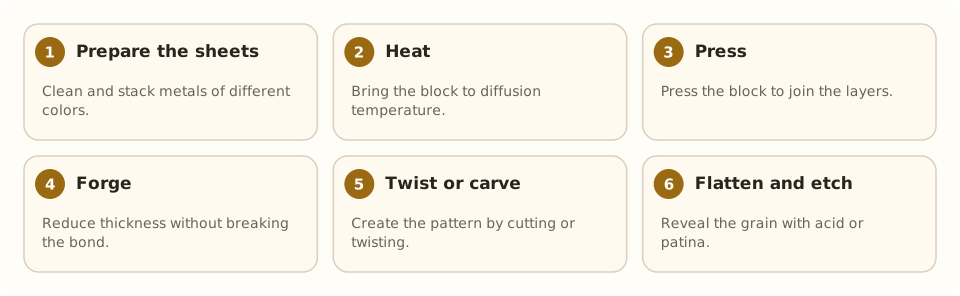
- Prepare the sheets. Clean and stack metals of different colors.
- Heat. Bring the block to diffusion temperature.
- Press. Press the block to join the layers.
- Forge. Reduce thickness without breaking the bond.
- Twist or carve. Create the pattern by cutting or twisting.
- Flatten and etch. Reveal the grain with acid or patina.
Tools and materials #
- Copper, silver, brass or alloy sheets
- Kiln or torch and press
- Rolling mill
- Acid or patinas to reveal the pattern
Common mistakes #
- Dirty sheets: they will not bond.
- Overheating: the layers melt.
- Not applying even pressure.
- Forging too fast: it delaminates.
See also #
This entry was drafted with the help of AI and is pending review by the author.
Related articles
 Techniques
Pavé setting
Pavé covers a metal surface with many small stones held by tiny beads of metal, as if “paved”; it gives continuous sparkle.
 Techniques
Burnishing: smoothing without removing metal
Burnishing smooths and shines metal by rubbing it with a polished steel tool, without removing material; used on bezels, prongs and as a final finish.
 Techniques
Metal clay (PMC)
Metal clay mixes silver or gold powder with a binder; it is hand-modeled and fired into solid metal. A modern, accessible technique.