Cloisonné: enamel in cells

In cloisonné, thin strips of metal soldered on edge form cells (“cloisons”) that are filled with colored enamel. When fired, each cell becomes a small piece of glass.
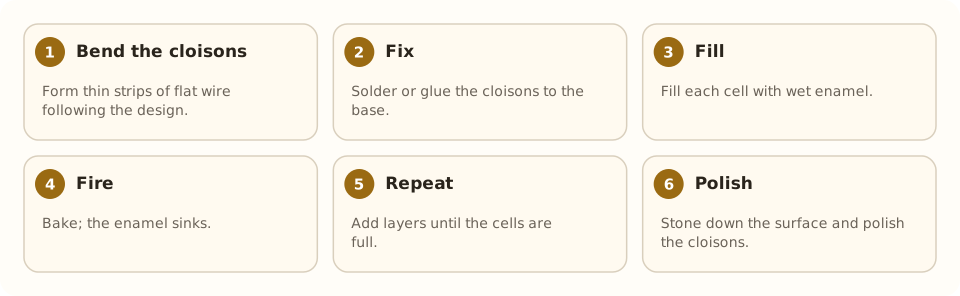
How it is done #
- The design is drawn and wires or strips of metal are bent along the lines.
- They are soldered on edge to the base.
- The cells are filled with enamel and fired.
- This is repeated until full, then sanded and polished until the wires and enamel are level.
History #
It is ancient: the Byzantines brought it to great refinement, and in China (jingtailan) and Japan it developed on vessels and jewelry.
Look #
Crisp metal lines separate fields of intense color, resembling stained glass.
Care #
It is durable, but a hard knock can chip the enamel.
Step by step #
- Bend the cloisons. Form thin strips of flat wire following the design.
- Fix. Solder or glue the cloisons to the base.
- Fill. Fill each cell with wet enamel.
- Fire. Bake; the enamel sinks.
- Repeat. Add layers until the cells are full.
- Polish. Stone down the surface and polish the cloisons.
Tools and materials #
Common mistakes #
- Cloisons that shift while filling.
- Colors mixing between cells.
- Not washing the enamel: it looks cloudy.
- Over-firing: the cloisons burn.
See also #
This entry was drafted with the help of AI and is pending review by the author.
Related articles
 Techniques
Pavé setting
Pavé covers a metal surface with many small stones held by tiny beads of metal, as if “paved”; it gives continuous sparkle.
 Techniques
Burnishing: smoothing without removing metal
Burnishing smooths and shines metal by rubbing it with a polished steel tool, without removing material; used on bezels, prongs and as a final finish.
 Techniques
Metal clay (PMC)
Metal clay mixes silver or gold powder with a binder; it is hand-modeled and fired into solid metal. A modern, accessible technique.