Plique-à-jour: enamel without a backing

Plique-à-jour (“letting in daylight”) is enamel that fills cells with no metal backing. With no base, light passes through it, as in a tiny stained-glass window.
How it is done #
- Cells are cut in the metal or a frame of wires is built.
- The cells are filled with translucent enamel, held by surface tension.
- It is fired carefully and repeated.
- It is polished on both sides.
Difficulty #
It is one of the hardest enameling techniques: the glass can break on cooling. That is why the pieces are delicate.
Style #
Closely associated with Art Nouveau (dragonfly wings, leaves), with examples by Lalique and Fabergé.
Care #
It is fragile: avoid knocks and do not clean it in an ultrasonic cleaner.
Step by step #
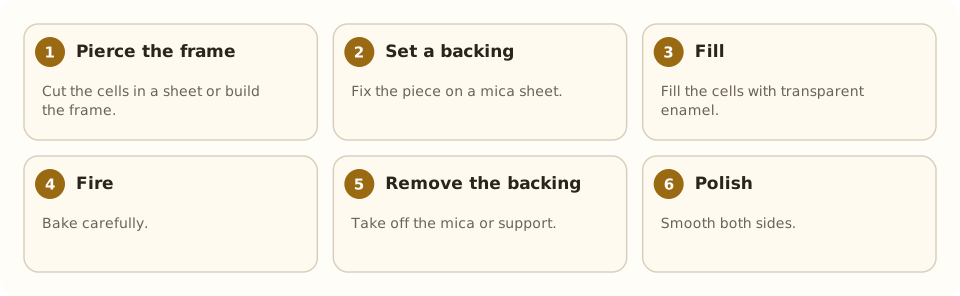
- Pierce the frame. Cut the cells in a sheet or build the frame.
- Set a backing. Fix the piece on a mica sheet.
- Fill. Fill the cells with transparent enamel.
- Fire. Bake carefully.
- Remove the backing. Take off the mica or support.
- Polish. Smooth both sides.
Tools and materials #
Common mistakes #
- Opaque enamel: it does not let light through.
- Cells too large: it breaks.
- Cooling suddenly: it cracks.
- Removing the support too soon.
See also #
This entry was drafted with the help of AI and is pending review by the author.
Related articles
 Techniques
Pavé setting
Pavé covers a metal surface with many small stones held by tiny beads of metal, as if “paved”; it gives continuous sparkle.
 Techniques
Burnishing: smoothing without removing metal
Burnishing smooths and shines metal by rubbing it with a polished steel tool, without removing material; used on bezels, prongs and as a final finish.
 Techniques
Metal clay (PMC)
Metal clay mixes silver or gold powder with a binder; it is hand-modeled and fired into solid metal. A modern, accessible technique.