Rolling and wire drawing: sheet and wire

Almost all the metal a jeweler uses comes from ingots that are rolled into sheet and drawn into wire.
Rolling #
The metal is passed through the rollers of a rolling mill, reducing the thickness a little at a time and annealing between passes. Grooved rollers make square, round and half-round wire.
Wire drawing #
The wire is stretched by pulling it through the decreasing holes of a draw plate, with beeswax as lubricant. Anneal when the wire stiffens.
Gauges #
Thickness is measured in millimeters or in gauges (AWG or B&S): the higher the gauge number, the finer the wire. 20 AWG is about 0.8 mm.
Tips #
Keep the rollers and draw plate clean, center the metal so it does not curve, and always roll in the same direction.
Step by step #
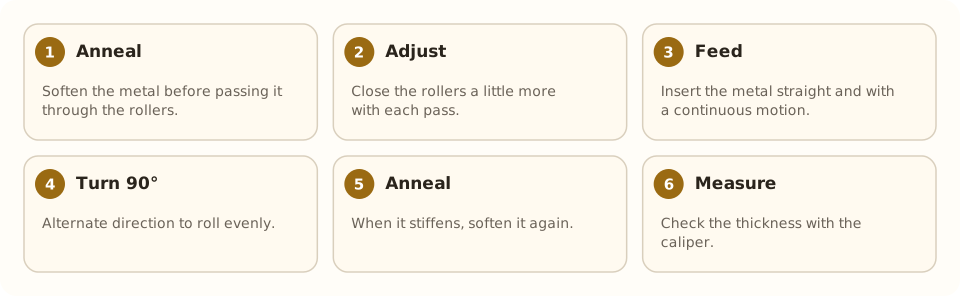
- Anneal. Soften the metal before passing it through the rollers.
- Adjust. Close the rollers a little more with each pass.
- Feed. Insert the metal straight and with a continuous motion.
- Turn 90°. Alternate direction to roll evenly.
- Anneal. When it stiffens, soften it again.
- Measure. Check the thickness with the caliper.
Tools and materials #
- Rolling mill
- Draw plate and draw tongs
- Caliper (see caliper)
- Beeswax
Common mistakes #
- Reducing too much in one pass: it cracks or curls.
- Feeding the metal crooked: it comes out wedge-shaped.
- Forgetting to anneal: the metal hardens and breaks.
- Leaving dirt on the rollers: it marks the sheet.
See also #
This entry was drafted with the help of AI and is pending review by the author.
Related articles
 Techniques
Pavé setting
Pavé covers a metal surface with many small stones held by tiny beads of metal, as if “paved”; it gives continuous sparkle.
 Techniques
Burnishing: smoothing without removing metal
Burnishing smooths and shines metal by rubbing it with a polished steel tool, without removing material; used on bezels, prongs and as a final finish.
 Techniques
Metal clay (PMC)
Metal clay mixes silver or gold powder with a binder; it is hand-modeled and fired into solid metal. A modern, accessible technique.