Chainmaille (maille weaving)

Chainmaille links separate rings in regular patterns. It began with medieval armor and today is used in bracelets, necklaces and earrings.
Patterns #
- European 4-in-1: each ring passes through four; the best known.
- Byzantine: forms a thick, compact chain.
- Japanese 12-in-2: a flat, sheet-like pattern.
- Persian: a mesh with a woven look.
Materials and tools #
Rings of aluminum, steel, copper, brass, silver and even rubber. Two pairs of pliers are needed to open and close each ring with a sideways twist, without pulling it apart.
Aspect ratio #
The ratio between the inside diameter of the ring and the wire thickness. It determines whether a pattern can be woven and how flexible it will be.
Tips #
Close each ring well so it does not open and start with large aluminum rings to practice.
Step by step #
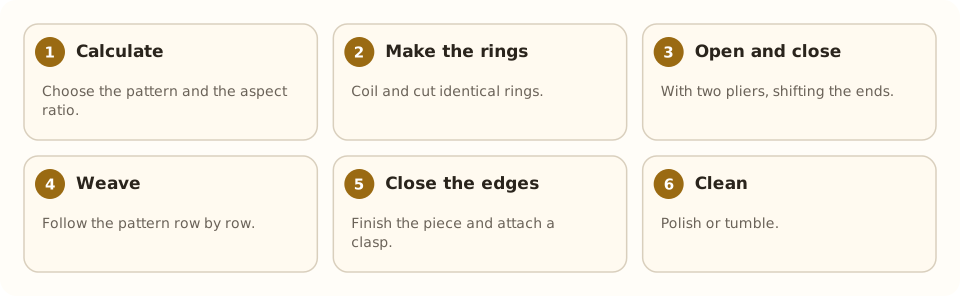
- Calculate. Choose the pattern and the aspect ratio.
- Make the rings. Coil and cut identical rings.
- Open and close. With two pliers, shifting the ends.
- Weave. Follow the pattern row by row.
- Close the edges. Finish the piece and attach a clasp.
- Clean. Polish or tumble.
Tools and materials #
- Aluminum, steel, copper or silver rings
- Two pairs of flat pliers
- Coiling mandrel
- Pattern diagrams
Common mistakes #
- Rings too small for the pattern: they will not fit.
- Badly closed rings that open.
- Mixing rings of different gauges.
- Weaving without checking the pattern: errors accumulate.
See also #
This entry was drafted with the help of AI and is pending review by the author.
Related articles
 Techniques
Pavé setting
Pavé covers a metal surface with many small stones held by tiny beads of metal, as if “paved”; it gives continuous sparkle.
 Techniques
Burnishing: smoothing without removing metal
Burnishing smooths and shines metal by rubbing it with a polished steel tool, without removing material; used on bezels, prongs and as a final finish.
 Techniques
Metal clay (PMC)
Metal clay mixes silver or gold powder with a binder; it is hand-modeled and fired into solid metal. A modern, accessible technique.