Sinking, raising and dapping: hollow forms

A flat sheet can become a volume: domes, bowls, hollow beads and bangles. The main techniques are sinking, raising and dapping.
Sinking #
The sheet is struck into a cavity of wood or metal (a sinking block) to hollow it out gradually.
Dapping #
With a dapping block and round-nosed punches, domes and half spheres are formed; two soldered halves make a hollow bead.
Raising #
The metal is hammered over a stake, in circles, annealing often, to raise the walls of a bowl or bangle.
Anticlastic raising #
A double opposing curvature, like that of a saddle. It is used in bangles with flowing lines.
Step by step #
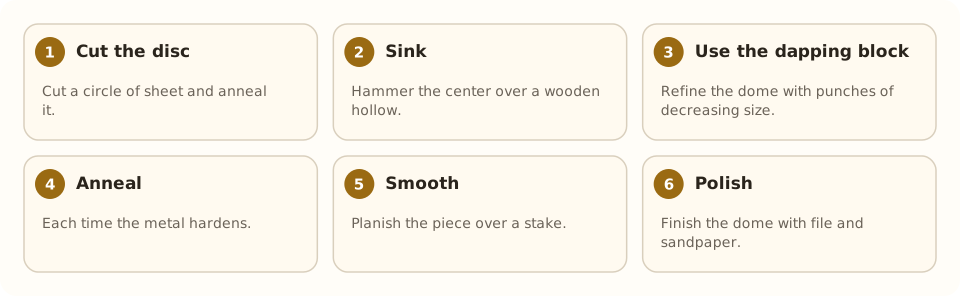
- Cut the disc. Cut a circle of sheet and anneal it.
- Sink. Hammer the center over a wooden hollow.
- Use the dapping block. Refine the dome with punches of decreasing size.
- Anneal. Each time the metal hardens.
- Smooth. Planish the piece over a stake.
- Polish. Finish the dome with file and sandpaper.
Tools and materials #
- Dapping block and punches
- Ball-peen hammer and mallet
- Stakes (anvil and stakes)
- Torch for annealing
Common mistakes #
- Striking too hard: the sheet wrinkles.
- Forgetting to anneal: cracks appear.
- Using a hollow smaller than the piece.
- Leaving hammer marks by not planishing.
See also #
This entry was drafted with the help of AI and is pending review by the author.
Related articles
 Techniques
Pavé setting
Pavé covers a metal surface with many small stones held by tiny beads of metal, as if “paved”; it gives continuous sparkle.
 Techniques
Burnishing: smoothing without removing metal
Burnishing smooths and shines metal by rubbing it with a polished steel tool, without removing material; used on bezels, prongs and as a final finish.
 Techniques
Metal clay (PMC)
Metal clay mixes silver or gold powder with a binder; it is hand-modeled and fired into solid metal. A modern, accessible technique.