Chasing and repoussé

Repoussé and chasing are two phases of the same technique: first the relief is raised from the back, then it is outlined from the front.
Repoussé #
The sheet rests on a soft surface (chaser's pitch) and is struck from behind with punches to push the metal outward and form volumes.
Chasing #
The piece is turned over and, with chisels and punches of different tips (tracers, liners, planishers, matting tools), details are defined, grounds smoothed and texture marked.
Materials and tools #
Chaser's pitch, held in a bowl or block; chasing hammers; punches; frequent annealing and a bath or heat to remove the pitch when finished.
History #
It has been known since ancient Egypt and Greece, and appears in masks, armor and cult objects. Today it is used in pendants, brooches and bangles.
Step by step #
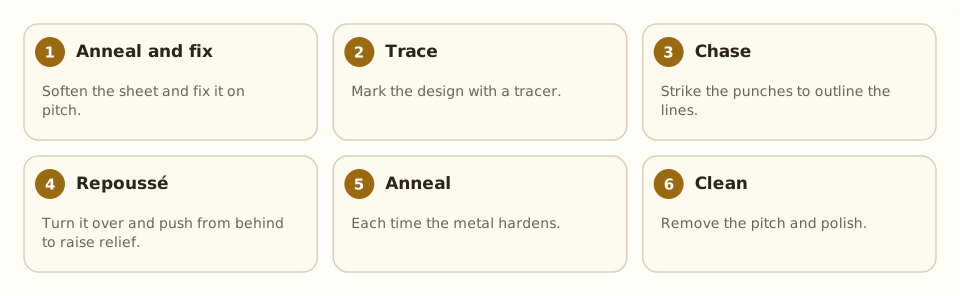
- Anneal and fix. Soften the sheet and fix it on pitch.
- Trace. Mark the design with a tracer.
- Chase. Strike the punches to outline the lines.
- Repoussé. Turn it over and push from behind to raise relief.
- Anneal. Each time the metal hardens.
- Clean. Remove the pitch and polish.
Tools and materials #
- Pitch or chasing putty
- Punches and chisels of various shapes
- Chasing hammer (hammers)
- Copper, brass or silver sheet
Common mistakes #
- Striking with uneven force: the relief is irregular.
- Not annealing in time: the sheet cracks.
- Pitch too hard or cold: the sheet will not give.
- Piercing the sheet with a sharp chisel.
See also #
This entry was drafted with the help of AI and is pending review by the author.
Related articles
 Techniques
Pavé setting
Pavé covers a metal surface with many small stones held by tiny beads of metal, as if “paved”; it gives continuous sparkle.
 Techniques
Burnishing: smoothing without removing metal
Burnishing smooths and shines metal by rubbing it with a polished steel tool, without removing material; used on bezels, prongs and as a final finish.
 Techniques
Metal clay (PMC)
Metal clay mixes silver or gold powder with a binder; it is hand-modeled and fired into solid metal. A modern, accessible technique.