Jeweler's hammers and mallets
A jeweler uses several small, precise hammers, each with its own purpose: shaping, smoothing, hardening or decorating.
Types #
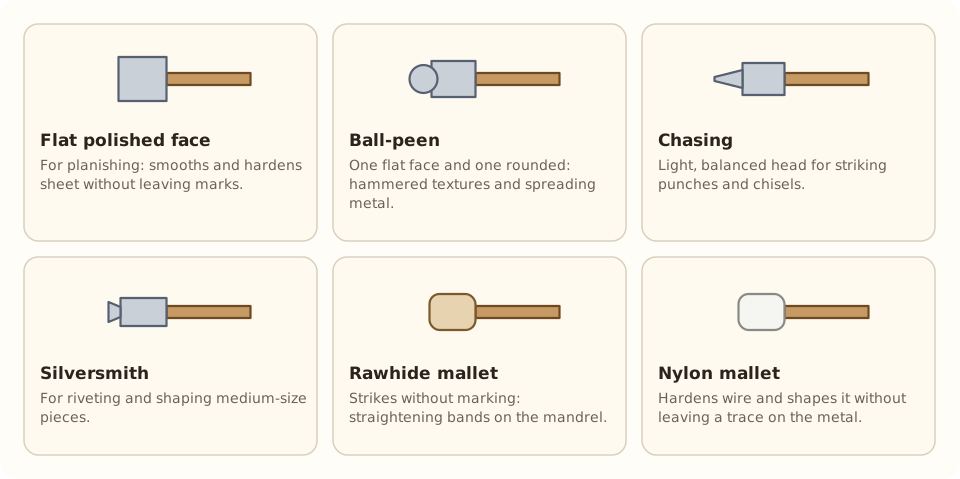
- Flat, polished face: planishing and smoothing.
- Ball: textures and expanding metal.
- Chasing: for repoussé.
- Riveting and silversmith hammers.
- Rawhide, nylon or wood mallets: shape without marking.
Care #
Keep faces polished and free of pits: they transfer to the metal. Store them separately.
Handle #
It should be comfortable and well fitted. A loose hammer is dangerous.
Use #
See forging and hammering and chasing and repoussé.
Which hammer for each job #
- Planishing (smoothing): flat polished-face hammer on a steel block.
- Texturing: ball-peen or ridged-face hammer.
- Shaping without marking: rawhide, nylon or wooden mallet.
- Chasing and repoussé: chasing hammer with punches.
- Riveting: silversmith or riveting hammer.
How to strike #
Hold the hammer toward the end of the handle, strike with the wrist and forearm rather than the shoulder, and keep the face parallel to the surface so as not to leave edge marks. Always rest the piece on a hard, clean base (anvil or steel block).
Work hardening #
Hammering hardens the metal (work hardening). If it starts to crack or becomes hard to work, it must be annealed before continuing.
Care #
Faces must be polished: a pit transfers to the metal. Store them apart and never strike hardened steel with them.
See also #
This entry was drafted with the help of AI and is pending review by the author.
Related articles
 Tools
Tools
Starter tool kit for jewelry making
Which basic tools you need to start making jewelry: pliers, saw, files, hammer, mandrel, torch and materials, with an indicative budget.
 Tools
Tools
Rolling mills: how to flatten metal
The rolling mill flattens and stretches metal into sheet and grooved wire; manual and electric types, how to use it and how to care for it.
 Tools
Tools
Draw plate
The draw plate is a steel plate with decreasing holes through which wire is pulled to thin it or change its section; how it is used.