Forging and hammering metal
To forge is to shape metal by striking it. In jewelry it is almost always done cold, with small, precise hammers on an anvil or steel block.
What it involves #
Striking compresses and moves the metal: a bar can be stretched, a sheet flattened or a wire curved. Non-ferrous metals such as gold, silver and copper work-harden as they are forged, and are softened again by annealing.
Common operations #
- Drawing out: lengthening a bar by striking it.
- Flattening and planishing: smoothing and hardening the surface with a polished-face hammer.
- Curving: forming rings and bangles over a mandrel.
- Texturing: leaving the hammer marks as decoration.
Tools #
Ball, planishing and flat-faced hammers and rawhide or plastic mallets; an anvil, a steel block, mandrels and stakes. Hammer faces must be polished: any mark transfers to the metal.
Tips #
Strike with the flat face and evenly, anneal when the metal stiffens and protect your ears: hammer work is noisy.
Step by step #
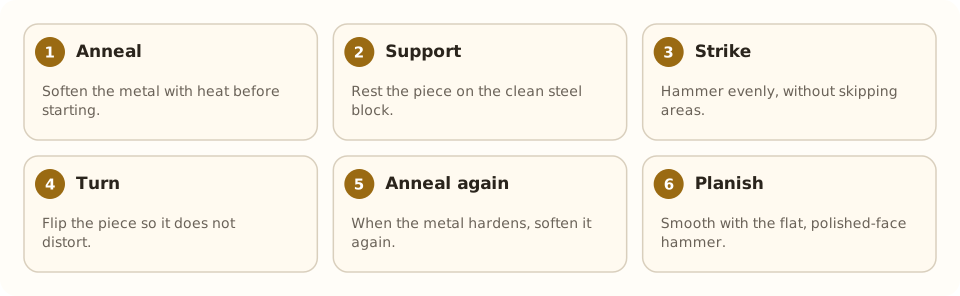
- Anneal. Soften the metal with heat before starting.
- Support. Rest the piece on the clean steel block.
- Strike. Hammer evenly, without skipping areas.
- Turn. Flip the piece so it does not distort.
- Anneal again. When the metal hardens, soften it again.
- Planish. Smooth with the flat, polished-face hammer.
Tools and materials #
- Forging and planishing hammers (see hammers)
- Steel block or anvil
- Torch for annealing
- Copper or silver sheet or rod to practice
Common mistakes #
- Continuing to hammer hard metal: it cracks.
- Striking with a dirty or pitted face: the marks transfer.
- Hitting one spot only and distorting the piece.
- Not caring for the steel block: its polish is lost.
See also #
This entry was drafted with the help of AI and is pending review by the author.
Related articles
 Techniques
Pavé setting
Pavé covers a metal surface with many small stones held by tiny beads of metal, as if “paved”; it gives continuous sparkle.
 Techniques
Burnishing: smoothing without removing metal
Burnishing smooths and shines metal by rubbing it with a polished steel tool, without removing material; used on bezels, prongs and as a final finish.
 Techniques
Metal clay (PMC)
Metal clay mixes silver or gold powder with a binder; it is hand-modeled and fired into solid metal. A modern, accessible technique.