Draw plate
The draw plate is a hardened steel plate with a series of holes of decreasing size. Pulling wire through them thins and lengthens it.
Types #
With round, square, oval and half-round holes, to give the wire the desired section.
Use #
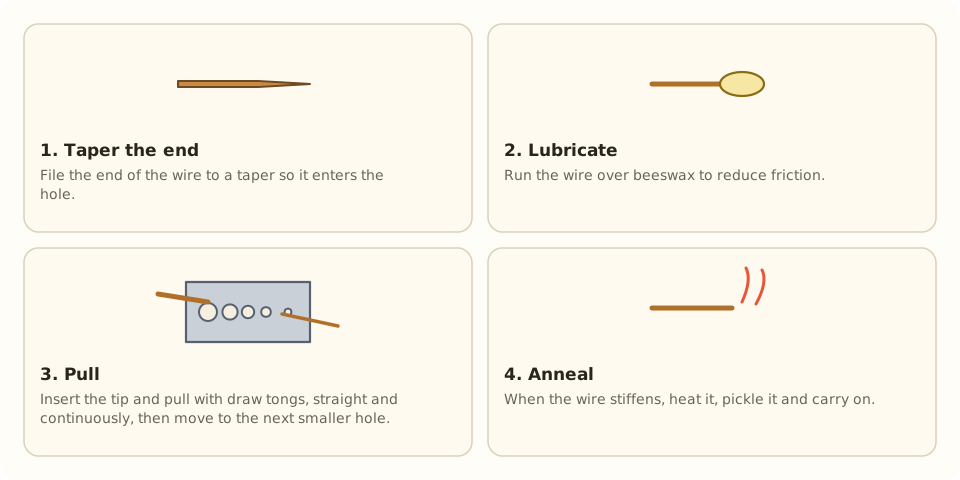
- Taper the end of the wire.
- Lubricate with beeswax.
- Pass it through the hole and pull with draw tongs, straight and continuously.
- Anneal the wire when it stiffens. See rolling and wire drawing.
Care #
Keep the plate clean and rust-free; do not hit it.
Alternatives #
The rolling mill with grooved rollers can produce sections without drawing.
What it achieves #
A draw plate lets you thin a wire (from 1.5 mm to 0.8 mm, for example), change its section (round, square, half-round) and make wire from a strip of metal. It is done in several steps through ever smaller holes; reducing too much at once breaks the wire.
How many steps #
Skip at most one hole and never jump to a much smaller one. When the wire feels like it is “biting” as you pull or stretches with difficulty, anneal it and continue.
Lubrication #
Beeswax is the most usual. Without lubrication the wire seizes and gets scratched.
Safety #
Clamp the plate in a bench vise or a holder; pull with draw tongs, not with your fingers, and keep your face away: a wire can come loose suddenly.
See also #
This entry was drafted with the help of AI and is pending review by the author.
Related articles
 Tools
Tools
Starter tool kit for jewelry making
Which basic tools you need to start making jewelry: pliers, saw, files, hammer, mandrel, torch and materials, with an indicative budget.
 Tools
Tools
Rolling mills: how to flatten metal
The rolling mill flattens and stretches metal into sheet and grooved wire; manual and electric types, how to use it and how to care for it.
 Tools
Tools
Jeweler's hammers and mallets
Jeweler's hammers (ball, planishing, chasing, flat-faced) and rawhide or nylon mallets are used to forge, texture and shape without marking.