Jewelry pliers and tweezers: types and uses
Pliers and tweezers are the tools most used at the jeweler's bench. Each shape serves a specific task.
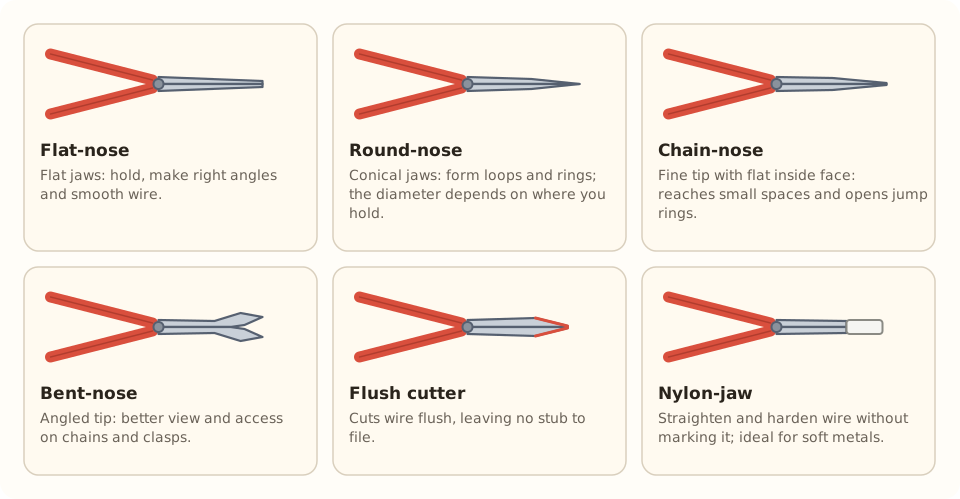
Types #
- Flat-nose: hold and make right angles.
- Round-nose: make loops and curves.
- Chain-nose: for working with wire and chains.
- Cutting (flush cutters): cut flush.
- Nylon-jaw: straighten without marking.
- Fine-point tweezers: to hold small pieces.
How to choose #
Smooth surfaces, jaws that close properly and a gentle spring that opens on its own. A small good-quality set beats many cheap ones.
Use #
Do not use fine-nose pliers to cut hard wire and do not force them: they go out of alignment.
Care #
Clean them, lubricate the hinge and store them dry.
Which pliers for each task #
| Task | Pliers |
|---|---|
| Making a ring or loop | Round-nose |
| Opening and closing jump rings | Two chain-nose (or flat) |
| Straightening wire | Nylon-jaw |
| Holding and bending at right angles | Flat-nose |
| Cutting flush | Flush cutter |
| Reaching a clasp or chain | Bent-nose |
How to open a jump ring #
Do not pull the ends apart outward: the ring loses its shape. Hold each side with pliers and move one end forward and the other back, as if opening a door. To close it, do the opposite movement.
How to care for pliers #
Avoid cutting hard wire with fine-nose pliers and do not force them: they go out of alignment. Clean the jaws, oil the hinge with a drop of oil now and then and store them dry.
Common mistakes #
- Marking the wire with serrated jaws (use smooth or nylon ones).
- Bending the wire back and forth: it hardens and breaks.
- Using a cutter on hard metal: the edges get nicked.
See also #
This entry was drafted with the help of AI and is pending review by the author.
Related articles
 Tools
Tools
Starter tool kit for jewelry making
Which basic tools you need to start making jewelry: pliers, saw, files, hammer, mandrel, torch and materials, with an indicative budget.
 Tools
Tools
Rolling mills: how to flatten metal
The rolling mill flattens and stretches metal into sheet and grooved wire; manual and electric types, how to use it and how to care for it.
 Tools
Tools
Draw plate
The draw plate is a steel plate with decreasing holes through which wire is pulled to thin it or change its section; how it is used.