Granulation: tiny spheres of gold

Granulation covers a piece with tiny metal spheres, sometimes under half a millimeter, that seem to float on the surface. It is associated above all with Etruscan goldwork.
How it is done #
- The granules are made by melting small pieces of metal on charcoal.
- They are placed on the surface with an adhesive paste containing copper salts.
- On heating, the copper and gold form a bond (a localized solder) that fixes the granules leaving no trace of solder.
Why it is difficult #
The heat must be just right: too little does not join the granules and too much melts them into the base. The granules have to be even and well placed.
History #
The Etruscans of the 7th century BCE brought it to a high level, and the technique was lost and later rediscovered.
Today #
It is used in luxury artisan jewelry and in archaeological reproductions.
Step by step #
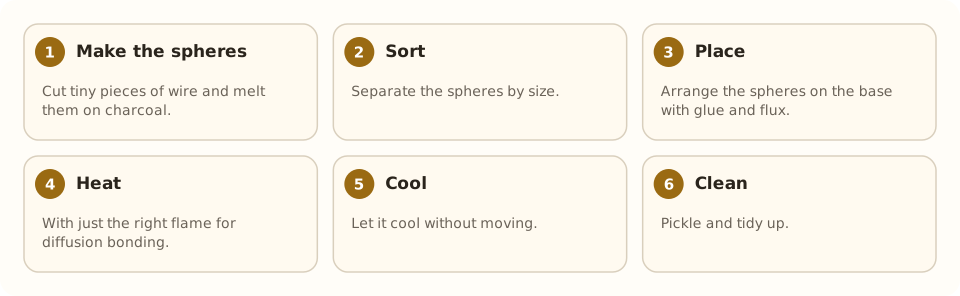
- Make the spheres. Cut tiny pieces of wire and melt them on charcoal.
- Sort. Separate the spheres by size.
- Place. Arrange the spheres on the base with glue and flux.
- Heat. With just the right flame for diffusion bonding.
- Cool. Let it cool without moving.
- Clean. Pickle and tidy up.
Tools and materials #
- Gold or silver wire and charcoal
- Fine brush and organic glue
- Fine tweezers (tweezers)
- Fine-tipped torch
Common mistakes #
- Overheating: the spheres melt into the base.
- Dirty spheres: they do not bond.
- Too much glue: carbon marks.
- Moving the piece while heating.
See also #
This entry was drafted with the help of AI and is pending review by the author.
Related articles
 Techniques
Pavé setting
Pavé covers a metal surface with many small stones held by tiny beads of metal, as if “paved”; it gives continuous sparkle.
 Techniques
Burnishing: smoothing without removing metal
Burnishing smooths and shines metal by rubbing it with a polished steel tool, without removing material; used on bezels, prongs and as a final finish.
 Techniques
Metal clay (PMC)
Metal clay mixes silver or gold powder with a binder; it is hand-modeled and fired into solid metal. A modern, accessible technique.