Jewelry finishes glossary: polish, satin, patina…
Surface finishes explained: roughing, sanding, polishing, buffing, satin, matte, brushed, textured, patina and mirror polish.
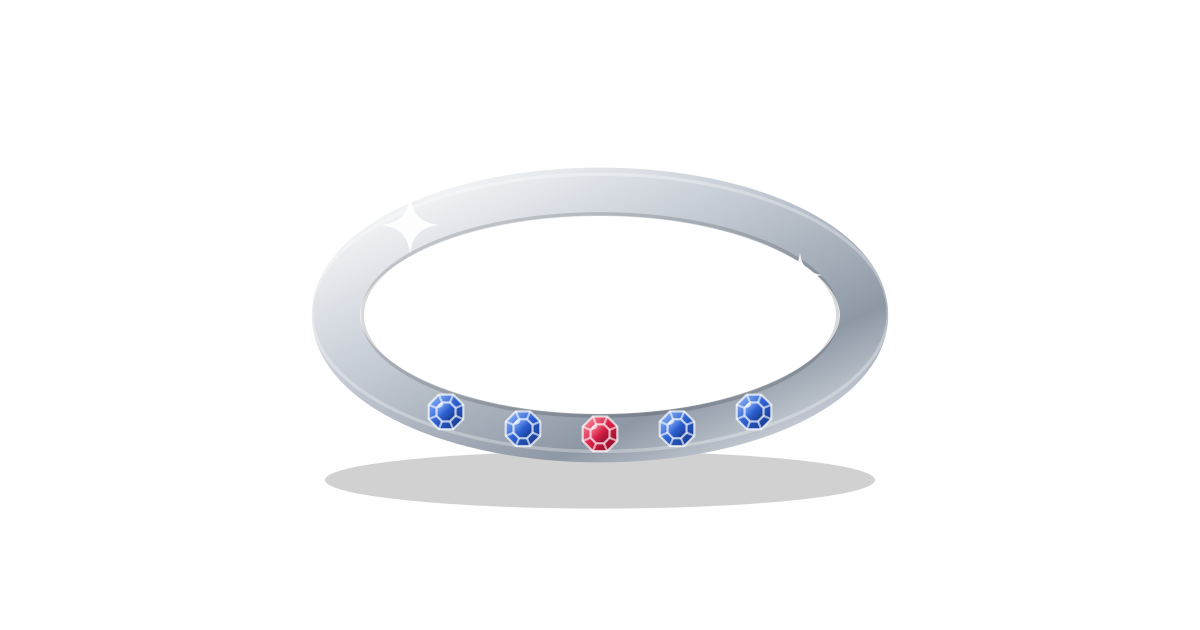
The finish is the last thing done to a jewel and the first thing seen. These are the terms, with their Spanish equivalent.
Preparing the surface #
- Roughing (desbaste): removing excess metal and large marks with files or burs.
- Sanding (lijado): working through papers of ever finer grit to erase earlier marks. See filing and sanding.
Shine #
- Polishing (pulido): leaving the surface smooth and bright with abrasive compounds. See polishing and buffing.
- Buffing (abrillantado): the last stage of polishing, with fine compounds such as rouge. See tripoli and rouge.
- Mirror polish (pulido espejo): a shine so perfect it reflects like a mirror; it shows every flaw.
Without shine #
- Satin finish (satinado): a soft sheen with very fine lines. See matte, satin and brushed.
- Matte (mate): a surface with no shine, made by bead blasting or sanding.
- Brushed (cepillado): parallel lines made with a brush or abrasive in one direction.
Relief and color #
- Textured (texturizado): hammered, engraved or otherwise marked. See texturing.
- Patina (patinado): a layer of color, by natural or induced oxidation. See coloring of metals.
- Oxidizing (oxidación): controlled darkening, for example with liver of sulfur, to bring out relief.
- Antique finish (acabado envejecido): dark patina in the recesses and polish on the high points, which gives the look of an old piece.
Protection #
Finishes can be protected with lacquer or wax: see lacquering and protection.
This entry was drafted with the help of AI and is pending review by the author.
Related articles
 Jeweler's dictionary
Jewelry workshop chemistry: pickle, flux, patinas and what not to mix
The chemicals of a jewelry workshop (pickle, flux, liver of sulfur, degreasers, plating baths) and which products must never be mixed.
 Jeweler's dictionary
Basic metalworking operations: cutting, filing, bending, annealing…
Basic jewelry metalworking operations defined one by one, with the Spanish term: cutting, piercing, filing, bending, annealing, forging, doming and riveting.
 Jeweler's dictionary
Basic metallurgy for jewelers: how metal behaves
Precious and base metal, alloy, fineness, karats, hardness, malleability, melting point, cold working and annealing: a jeweler's basic metallurgy.
 Jeweler's dictionary
Jewelry construction glossary: jump ring, post, hinge, bail…
The components of a jewel with the names used in the workshop: loop, jump ring, band, post, clasp, lobster clasp, hinge, bail, tube and mounting.