Basic metallurgy for jewelers: how metal behaves
Precious and base metal, alloy, fineness, karats, hardness, malleability, melting point, cold working and annealing: a jeweler's basic metallurgy.
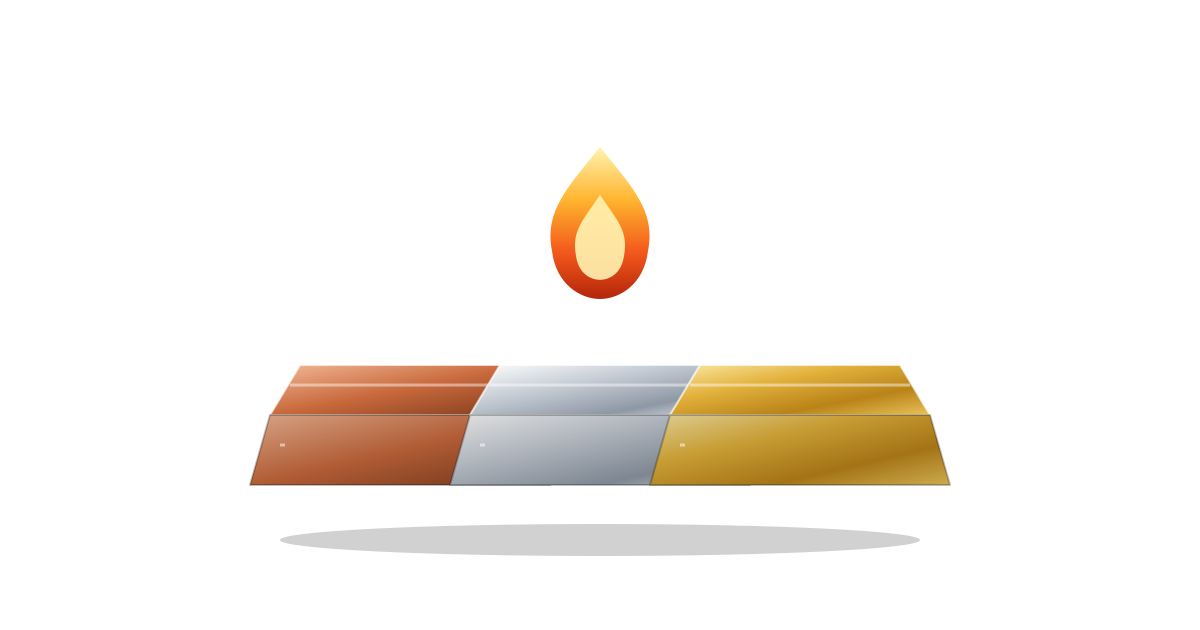
Understanding how metal behaves explains why it cracks, why it needs annealing or why a piece changes size when cast. These are the key ideas.
Kinds of metal #
- Precious metal (metal precioso): gold, silver, platinum and palladium, among others. They are scarce and resist corrosion.
- Base metal (metal base): copper, brass, bronze, steel, aluminum… They are cheaper and some of them tarnish.
- Alloy (aleación): a mix of metals to change hardness, color or melting point. See jewelry alloys.
Purity #
- Fineness (ley): the proportion of pure metal, in thousandths. Sterling 925 means 925 parts silver in every 1000. See 925 silver.
- Karat (quilataje): the purity of gold in 24 parts. 18-karat gold is 18/24 gold, that is, 750 thousandths. It is not the same as the carat of gems: see carat and karat.
- Purity (pureza): the general term for pure-metal content.
Mechanical properties #
- Hardness (dureza): resistance to scratching or deformation. It is not the same as the Mohs hardness of gems.
- Malleability (maleabilidad): the ability to be flattened into sheet without breaking. Gold and silver are very malleable.
- Ductility (ductilidad): the ability to be drawn into wire. It is the basis of wire drawing.
Heat #
- Melting point (punto de fusión): pure gold melts at about 1064 °C, pure silver at about 962 °C, copper at about 1085 °C and platinum at about 1768 °C.
- Melting temperature of an alloy: not a single point but a range between the start (solidus) and the end (liquidus) of melting.
- Shrinkage (contracción): metal shrinks as it cools, which is allowed for when casting.
Changes when you work metal #
- Cold working (trabajo en frío): hammering, rolling, bending or drawing at room temperature. It hardens the metal and makes it brittle. Also called work hardening.
- Internal stress (tensión del metal): stress built up by working it; it can warp or crack the piece later.
- Annealing (recocido): heating the metal to remove hardness and stress and recover malleability. See annealing.
- Hot working (trabajo en caliente): forging and other processes at high temperature, where the metal is softer.
- Oxidation (oxidación): a reaction with oxygen; on copper and sterling silver it forms dark oxides. See pickling.
The practical rule #
Work the metal until you feel it push back, anneal it and carry on. Ignoring this is the most common cause of cracks.
See also: Basic metalworking operations.
This entry was drafted with the help of AI and is pending review by the author.
Related articles
 Jeweler's dictionary
Jewelry construction glossary: jump ring, post, hinge, bail…
The components of a jewel with the names used in the workshop: loop, jump ring, band, post, clasp, lobster clasp, hinge, bail, tube and mounting.
 Jeweler's dictionary
Measuring and calculating in jewelry: gauge, sizes and metal weight
Gauge, thickness, diameter, ring size, density and how to calculate the weight of a piece or the length of metal for a ring, with formulas and examples.
 Jeweler's dictionary
Jewelry finishes glossary: polish, satin, patina…
Surface finishes explained: roughing, sanding, polishing, buffing, satin, matte, brushed, textured, patina and mirror polish.
 Jeweler's dictionary
Jewelry design glossary: sketch, prototype, mock-up, tolerance
The words of creating a piece: sketch, technical drawing, scale, template, prototype, mock-up, model, ergonomics and tolerance.