Cold connections: rivets, screws and staples
Not every piece can be soldered. Cold connections (rivets, tabs, staples, screws) join dissimilar metals and heat-sensitive materials such as wood, leather or enamel.
Rivets #
A wire rivet is passed through a hole and flattened at both ends to form two heads. Tube rivets allow pieces that pivot. Drill the holes precisely.
Tabs and staples #
A tab cut in one piece is bent over another to hold it, with no solder. Wire staples pass through and are bent behind.
Screws and nuts #
Used in contemporary jewelry and for detachable pieces; the hole is tapped with a screw plate.
When to choose them #
When joining different materials, when you do not want to heat the piece, or when the connection is part of the design.
Step by step #
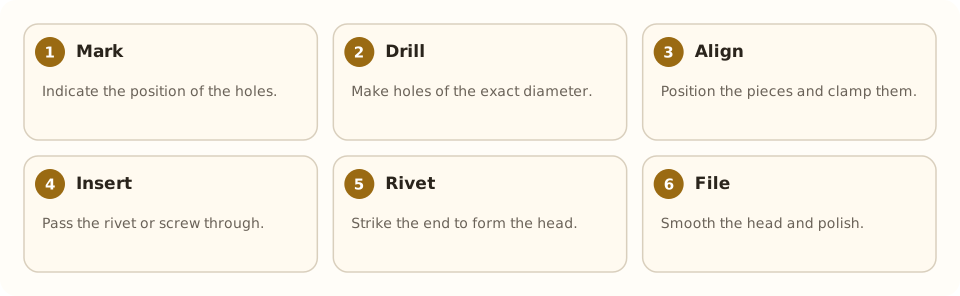
- Mark. Indicate the position of the holes.
- Drill. Make holes of the exact diameter.
- Align. Position the pieces and clamp them.
- Insert. Pass the rivet or screw through.
- Rivet. Strike the end to form the head.
- File. Smooth the head and polish.
Tools and materials #
- Wire or tube for rivets
- Drill and bits
- Riveting hammer
- Small screws and nuts
Common mistakes #
- Hole bigger than the rivet: it ends up loose.
- Striking too much: the piece distorts.
- Riveting on a soft base.
- Forgetting the play in articulated joints.
See also #
This entry was drafted with the help of AI and is pending review by the author.
Related articles
 Techniques
Pavé setting
Pavé covers a metal surface with many small stones held by tiny beads of metal, as if “paved”; it gives continuous sparkle.
 Techniques
Burnishing: smoothing without removing metal
Burnishing smooths and shines metal by rubbing it with a polished steel tool, without removing material; used on bezels, prongs and as a final finish.
 Techniques
Metal clay (PMC)
Metal clay mixes silver or gold powder with a binder; it is hand-modeled and fired into solid metal. A modern, accessible technique.