Cabochon cutting

A cabochon is a stone polished into a smooth dome, flat underneath. It is the cut for opaque or translucent stones, such as opal, turquoise or tiger's eye. The name comes from the Norman word “caboche” (head).
How it is cut #
- A slab is cut and the outline drawn.
- The stone is glued to a dop stick.
- It is roughed out on a wheel and shaped into a dome with ever finer grits.
- It is polished with a very fine abrasive (cerium, aluminum or tin oxide) on leather, felt or a cloth lap.
Which stones #
Opal, turquoise, lapis lazuli, agate, tiger's eye, moonstone, and stones with light effects such as cat's eye or star.
Setting #
They are mostly set in a bezel, which protects the edge and holds the flat-backed stone.
Tips #
A dome that is too high breaks easily; the base must be flat to seat well.
Step by step #
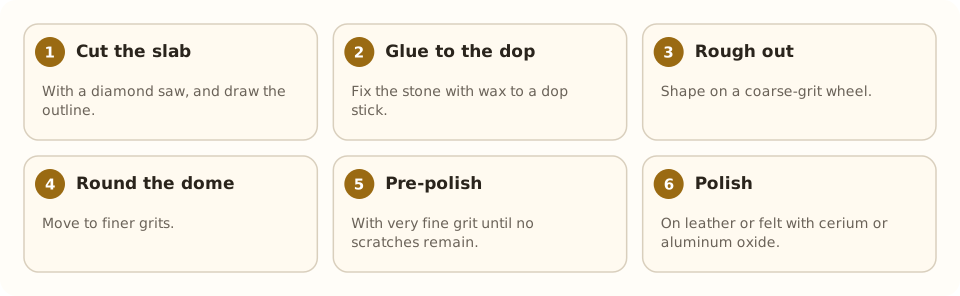
- Cut the slab. With a diamond saw, and draw the outline.
- Glue to the dop. Fix the stone with wax to a dop stick.
- Rough out. Shape on a coarse-grit wheel.
- Round the dome. Move to finer grits.
- Pre-polish. With very fine grit until no scratches remain.
- Polish. On leather or felt with cerium or aluminum oxide.
Tools and materials #
- Diamond saw and cabochon machine
- Dop sticks and wax
- Wheels or laps of decreasing grit
- Cerium, aluminum or tin oxide for polishing
Common mistakes #
- Dome too high: it breaks.
- Base not flat: it will not fit the setting.
- Stone overheating from lack of water.
- Skipping grits: scratches remain.
See also #
This entry was drafted with the help of AI and is pending review by the author.
Related articles
 Techniques
Pavé setting
Pavé covers a metal surface with many small stones held by tiny beads of metal, as if “paved”; it gives continuous sparkle.
 Techniques
Burnishing: smoothing without removing metal
Burnishing smooths and shines metal by rubbing it with a polished steel tool, without removing material; used on bezels, prongs and as a final finish.
 Techniques
Metal clay (PMC)
Metal clay mixes silver or gold powder with a binder; it is hand-modeled and fired into solid metal. A modern, accessible technique.