Gemstone faceting

A faceted gem has flat, polished surfaces (facets), placed precisely so that light enters, reflects and exits toward the eye. It is the cut for transparent stones.
The faceting machine #
The stone is glued to a rod (mast) and rests on a rotating lap. The angle and the “index” (the rotated position) are controlled precisely to cut each facet.
Stages #
- The pavilion (the lower part) is cut.
- The crown (the upper part) and the table are cut.
- Each facet is polished with a fine abrasive, often diamond on a lap.
Angles matter #
Each gem has a refractive index, and the pavilion angles are calculated so that light reflects inside and does not leak out the back.
Cuts #
Brilliant, princess, emerald, cushion, pear, marquise… See types of gem cut.
Step by step #
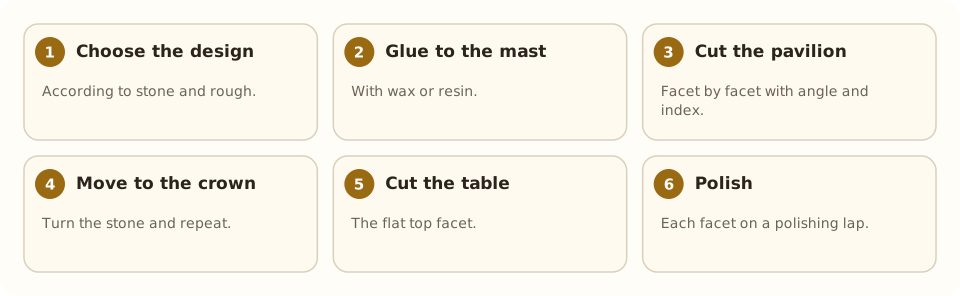
- Choose the design. According to stone and rough.
- Glue to the mast. With wax or resin.
- Cut the pavilion. Facet by facet with angle and index.
- Move to the crown. Turn the stone and repeat.
- Cut the table. The flat top facet.
- Polish. Each facet on a polishing lap.
Tools and materials #
- Faceting machine
- Diamond laps of various grits
- Polishing laps
- Cutting diagrams
Common mistakes #
- Wrong angles: the stone loses sparkle.
- Facets that do not meet at a point.
- Not cleaning between laps.
- Overheating and fracturing the stone.
See also #
This entry was drafted with the help of AI and is pending review by the author.
Related articles
 Techniques
Pavé setting
Pavé covers a metal surface with many small stones held by tiny beads of metal, as if “paved”; it gives continuous sparkle.
 Techniques
Burnishing: smoothing without removing metal
Burnishing smooths and shines metal by rubbing it with a polished steel tool, without removing material; used on bezels, prongs and as a final finish.
 Techniques
Metal clay (PMC)
Metal clay mixes silver or gold powder with a binder; it is hand-modeled and fired into solid metal. A modern, accessible technique.