Catalog of chain links
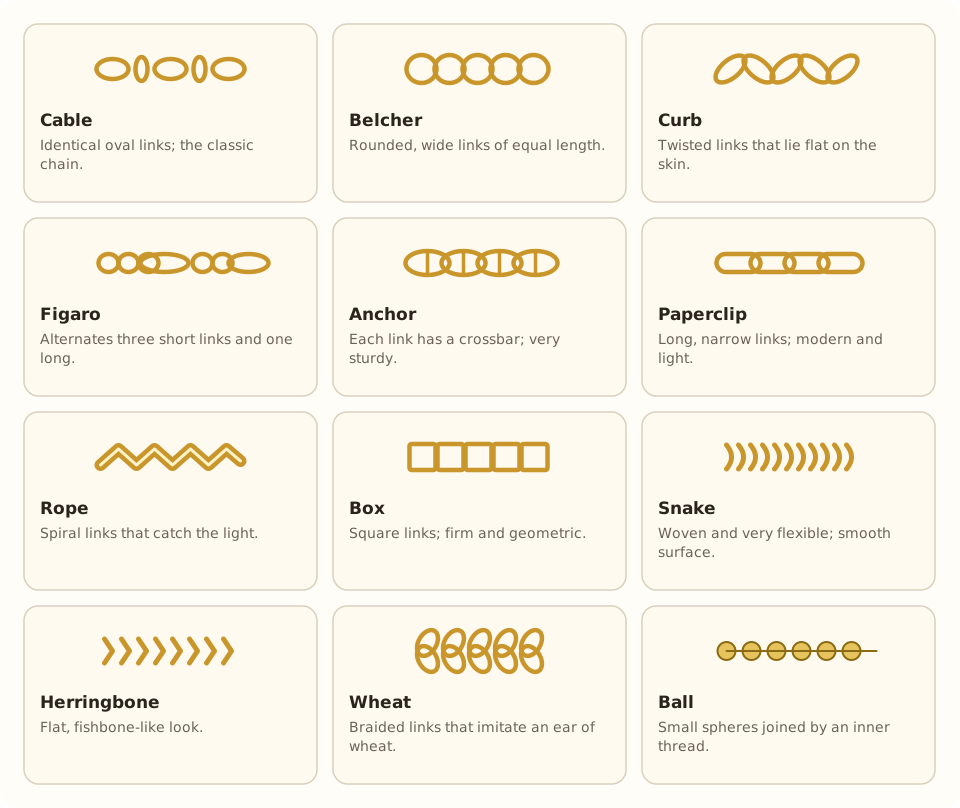
A catalog of the main chain designs. Each has its character and behavior: some are more flexible, others sturdier. See also types of chain.
Separate links #
- Cable or rolo: identical oval links.
- Belcher: wide, rounded links of equal length.
- Curb and Cuban: twisted links that lie flat.
- Figaro: alternates short and long links.
- Anchor or mariner: with a crossbar in each link.
- Paperclip: long, narrow links.
Woven and braided #
- Rope: links in a spiral.
- Byzantine: complex, thick braid.
- Singapore: twisted links that sparkle.
- Wheat: links that imitate an ear of wheat.
- Herringbone: flat, fishbone-like.
- Venetian and box: square links.
Smooth and flexible #
- Snake: woven, round or flat, very flexible.
- Milanese: flat, fine mesh.
- Omega: a flexible tube of scales.
Ball and bead #
- Ball: small joined spheres.
- Bead or pearl: strung beads.
Thickness and length #
Thickness is measured in millimeters and length in centimeters. A fine chain (1 mm) is delicate and discreet; a thick one (4 mm or more) is firm and eye-catching. For pendants, choose a thickness that suits the weight. See what length to choose.
Which chain for each use #
- With a pendant: cable, box or snake (the pendant slides well).
- Everyday: belcher, anchor or paperclip (resistant).
- To stand out: rope, Singapore or Byzantine.
- For men: Cuban, anchor or thick herringbone.
- For a bracelet: cable, curb or figaro.
Solidity and flexibility #
Hollow chains weigh less and look big, but they dent; solid ones are firmer and last longer. Woven ones (snake, Milanese) are flexible but hard to repair. If a chain breaks, see how to fix a chain.
Handmade chains #
Many of these chains can be made by hand, link by link (handmade chains) or with the chainmaille technique.
See also #
This entry was drafted with the help of AI and is pending review by the author.
Related articles
 Jewelry
Seals in jewelry: Mesopotamian cylinders, scarabs and intaglios
Engraved stone seals are among the oldest jewels: Mesopotamian cylinders, Egyptian scarabs, Roman intaglios and Chinese seals; what they are and how they were used.
 Jewelry
Parts of a piece of jewelry: ring, earring, necklace and bracelet
Vocabulary of the parts of a jewel: head, prongs, shoulders and shank of the ring; post and back of the earring; chain, clasp and bail of the necklace.
 Jewelry
Tiaras: what they are, styles and how to choose one
A tiara is a semicircular headpiece worn at the front of the hair; history, styles (halo, kokoshnik, floral), materials and how to choose one for a wedding.