Symbols in traditional jewelry and their meaning
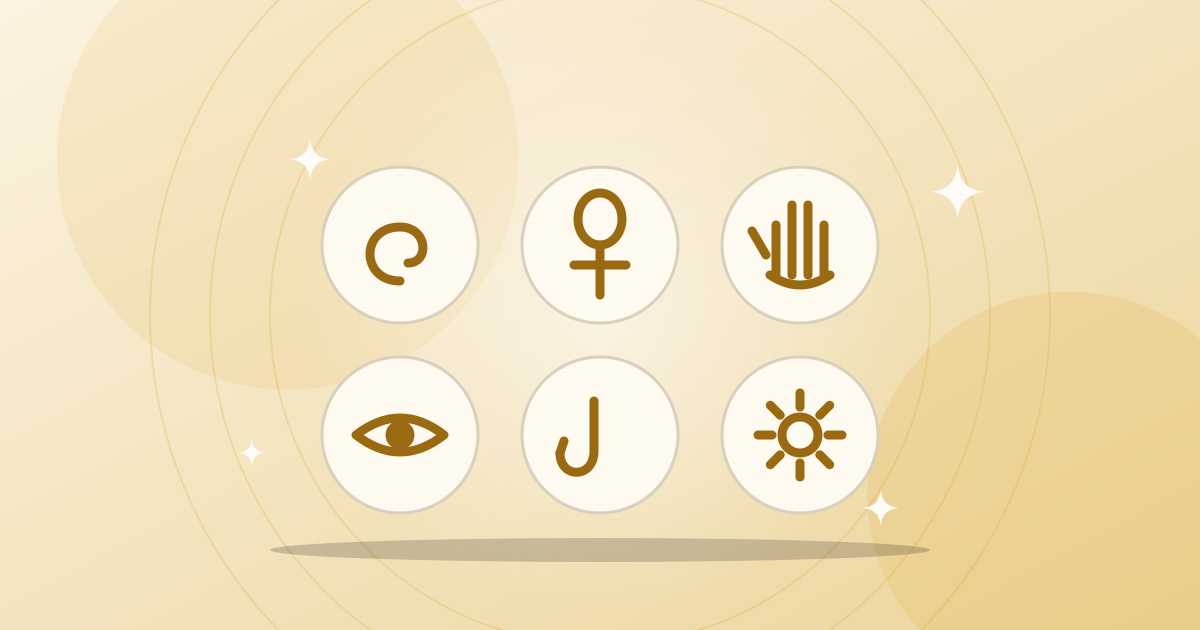
Many traditional jewels carry symbols that express protection, life, journey or belonging. This guide gathers some of the best known, with their origin and the meaning usually attributed to them.
A reference table #
| Symbol | Origin | Associated meaning |
|---|---|---|
| Ankh | Ancient Egypt | Life |
| Scarab | Ancient Egypt | Rebirth and protection |
| Eye of Horus (udjat) | Ancient Egypt | Protection and health |
| Hand of Fatima (khamsa) | North Africa and the Middle East | Protection against the evil eye |
| Blue eye (nazar) | Turkey and the eastern Mediterranean | Protection against the evil eye |
| Jet higa | Spain | Protection against the evil eye |
| Koru | Māori (New Zealand) | New life, growth and peace |
| Hei matau | Māori (New Zealand) | Prosperity and safe travel over water |
| Sankofa | Akan (Ghana) | Learning from the past |
| Gye Nyame | Akan (Ghana) | The supremacy of God |
| Naja | Navajo (US) | Protection |
| Turquoise | US Southwest, Middle East and others | Protection, health, sky and water |
| Jade | Mesoamerica and China | Life, water and purity |
| Spondylus (mullu) | Andes | Water, fertility and offering |
| Tumi | Andes (Peru) | Ceremonial knife; cultural symbol of Peru |
| Mangalsutra | India | Marriage |
| Sølje | Sámi | Its jingling keeps evil spirits away |
How to read symbols #
The same symbol can mean different things depending on the community, the period and the context. The hand of Fatima, for example, has readings in Muslim and Jewish traditions and wide popular use. The most respectful approach is to ask the people who made it and to avoid assigning a single meaning.
Materials with meaning #
Some materials, besides their beauty, carry symbolic value in many cultures: jet as protection, amber as a warm stone, red coral as an amulet, mother-of-pearl and pearls tied to water and the moon, and gold and silver tied to the sun and the moon.
See also #
This entry was drafted with the help of AI and is pending review by the author.
Related articles
 Jewelry around the world
Pre-Columbian gold of Colombia
The Muisca, Quimbaya and Tairona worked gold in Colombia with lost-wax casting: tunjos, poporos and offerings of sacred value.
 Jewelry around the world
Emberá chaquira beadwork
Emberá women of Colombia and Panama create necklaces and ornaments with chaquira, tiny glass beads in geometric designs.
 Jewelry around the world
Tuareg and Amazigh jewelry
Silver, amber, coral and enamel in Tuareg and Amazigh jewelry from the Sahara and the Maghreb: amulets, fibulae and protective crosses.