Crowns: history, types and materials
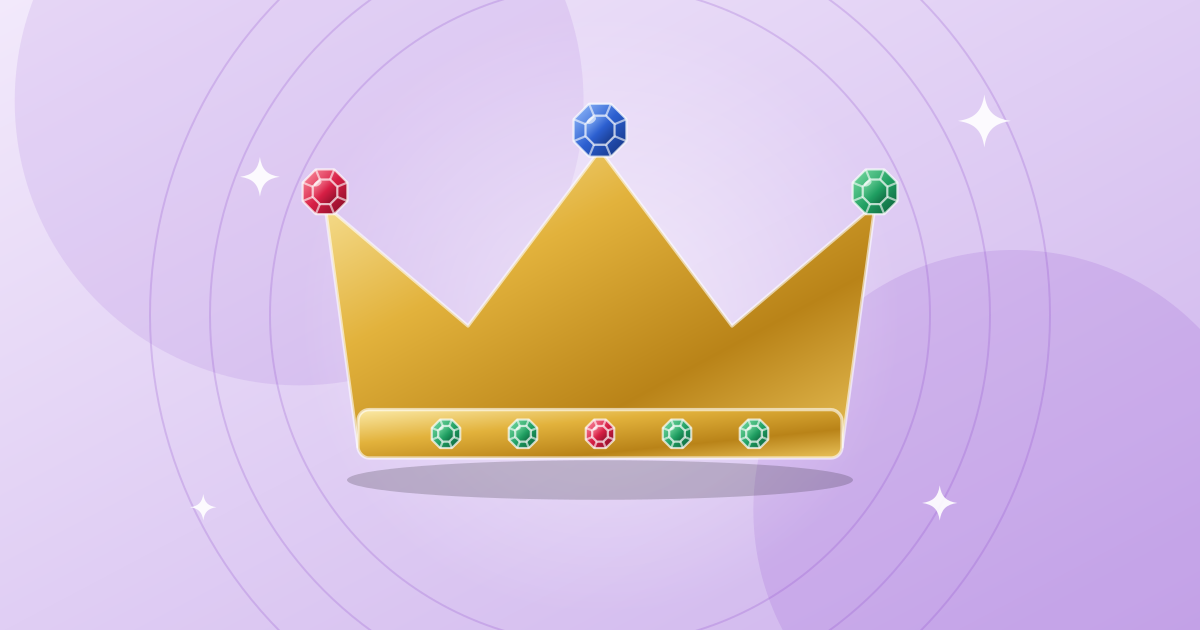
The crown is the jewel that symbolizes sovereignty, victory or dignity. Worn on the head, it has taken very different forms through history depending on culture and period.
A little history #
In ancient Greece and Rome, victors were crowned with wreaths of laurel, olive or myrtle. In Egypt, pharaohs' crowns combined symbols of Upper and Lower Egypt. In medieval Europe, the metal crown with arches and gems became the emblem of monarchs. In Korea, the gold crowns of Silla (5th-6th centuries) are famous for their leaves and jade pendants.
Types of crown #
- Wreath or laurel crown: of natural leaves or of metal.
- Diadem or circlet: a band that encircles the head.
- Closed crown: with arches that meet over the head, typical of monarchies.
- Coronet or rank crown: for the nobility, with a different number of strawberry leaves or pearls depending on the title.
- Bridal and festive crowns: of flowers, pearls or crystals.
Materials and techniques #
Historic crowns are made of gold or silver-gilt, set with gems, pearls and enamel. They are worked by hammering, chasing, openwork and lost-wax casting. Today there are crowns of inexpensive metals and crystal for weddings and parties.
Symbolism #
It stands for power, honor and triumph, but also for dignity and celebration. That is why it appears in heraldry, religion and fashion.
See also #
This entry was drafted with the help of AI and is pending review by the author.
Related articles
 Jewelry
Seals in jewelry: Mesopotamian cylinders, scarabs and intaglios
Engraved stone seals are among the oldest jewels: Mesopotamian cylinders, Egyptian scarabs, Roman intaglios and Chinese seals; what they are and how they were used.
 Jewelry
Parts of a piece of jewelry: ring, earring, necklace and bracelet
Vocabulary of the parts of a jewel: head, prongs, shoulders and shank of the ring; post and back of the earring; chain, clasp and bail of the necklace.
 Jewelry
Tiaras: what they are, styles and how to choose one
A tiara is a semicircular headpiece worn at the front of the hair; history, styles (halo, kokoshnik, floral), materials and how to choose one for a wedding.