Jeweler's saw and saw blades
The jeweler's saw is a metal frame in which a fine saw blade is tensioned. It makes precision cuts in metal.
Frame and blades #
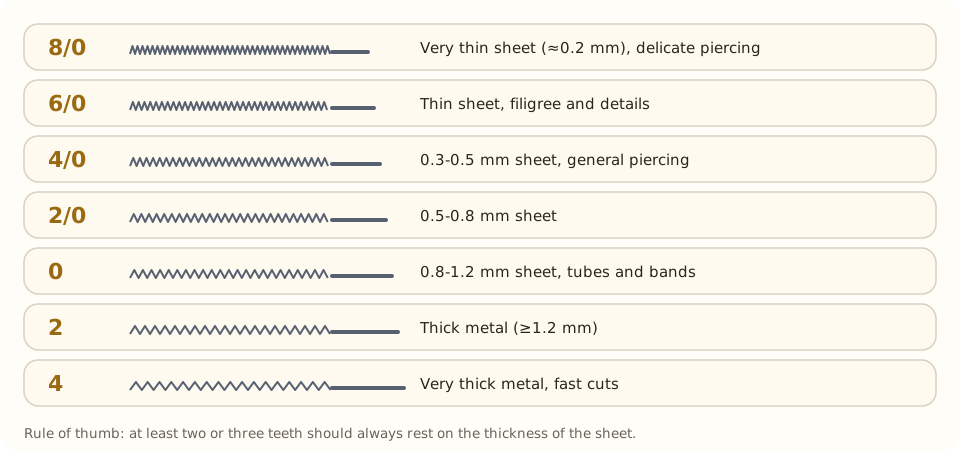
The frame is adjustable to the blade length. Blades are numbered, from very fine (8/0) to coarse (8): the higher the number, the thicker.
How to fit the blade #
With the teeth facing the handle and downward, tension the blade with the piece resting, and fix the other end.
How to cut #
Lubricate with wax, saw with long vertical strokes, without forcing. See sawing and piercing.
Tips #
Change the blade when it dulls; having spares to hand avoids interruptions.
How to fit the blade #
- Loosen the clamp on the handle and the one at the far end.
- With the teeth pointing down and toward the handle, fix the blade in the handle.
- Press the frame against the edge of the bench to shorten it slightly.
- Fix the other end and release: the blade is taut. When plucked it should ring like a high note.
How it is cut #
Lubricate the blade with wax. Hold the piece on the bench pin, saw with long vertical strokes and let the blade do the work without pushing. Turn the piece —not the saw— to follow a curve, and do not force tight turns: saw up and down in place while you turn.
Why blades break #
- Too much pressure or hurry.
- Slack or badly fitted blade.
- Blade too fine for the thickness of the metal.
- Twisting the frame in the cut. Having spare blades at hand avoids interruptions.
What saws exist #
The standard jeweler's saw serves for nearly everything. Deep-throat frames allow piercing large pieces far from the edge; adjustable frames fit shorter, broken blades.
See also #
This entry was drafted with the help of AI and is pending review by the author.
Related articles
 Tools
Tools
Starter tool kit for jewelry making
Which basic tools you need to start making jewelry: pliers, saw, files, hammer, mandrel, torch and materials, with an indicative budget.
 Tools
Tools
Rolling mills: how to flatten metal
The rolling mill flattens and stretches metal into sheet and grooved wire; manual and electric types, how to use it and how to care for it.
 Tools
Tools
Draw plate
The draw plate is a steel plate with decreasing holes through which wire is pulled to thin it or change its section; how it is used.